
Adaptive Desk for Sofia
Lead Designer
THE CHALLENGE
Custom design a desk that would support her unique writing position and be adaptable for her home and school.
THE OUTCOME
designed and built an adjustable wooden desk using donated materials, ensuring it was ergonomic, transportable, and adaptable to different seating conditions.
MY ROLE
Led the research, ideation, and design process, collaborated with a furniture factory for material sourcing and fabrication, and oversaw prototyping and final assembly.
SKILLS
Human-centered design
Teamwork
Interdisciplinary work
Inclusive design
Remote collaboration
Our client
This is Sofia
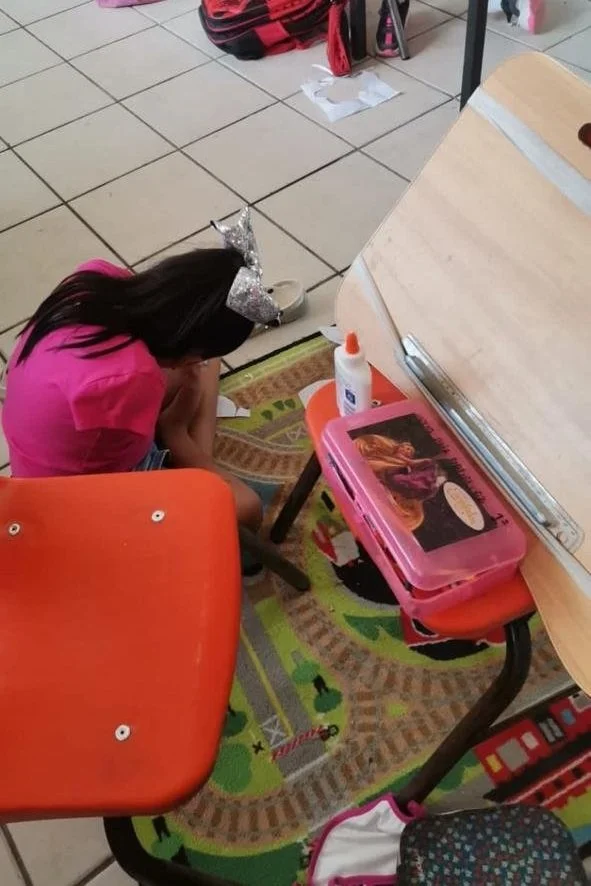
a bright and determined little girl living in a rural area near Saltillo. Born without hands, she adapted by learning to write with her feet. However, the posture she had to maintain while writing was starting to cause serious back problems. Her school, a small rural institution, lacked any accommodations to support her unique needs. Concerned about her long-term health, her teacher reached out to CAPTA, hoping to find a way to help Sofia continue her education comfortably and independently.

Outcome
The outcome
Sofia now has a workspace that supports her posture, preventing further spinal strain.
The adjustable desk allows her to use it in multiple settings, improving accessibility.
The project demonstrated the impact of community collaboration, with local businesses and individuals coming together to make it possible.
This project reinforced our ability to design user-centered solutions with minimal resources, proving that even small interventions can have a significant impact.

Constraints and limitations
-
Since Sofia lived in a rural area near Saltillo, we were unable to meet her in person during the initial design phase. Instead, we had to rely on video calls with her teacher to assess her needs, understand her environment, and gather feedback throughout the process. This added complexity, as we had to interpret measurements and requirements remotely without direct access to the user.
-
The desk needed to be functional both at home and at school. Since Sofia’s school provided only small children's chairs, we designed adjustable legs to ensure compatibility with different seating options.
-
Sofia came from a low-income background, and her public rural school did not have any budget to fund the desk. This meant we had to find cost-effective solutions and rely on donated or repurposed materials.
-
Since we were designing a wooden desk but had no prior experience working with wood, we needed external support. We partnered with a local furniture factory, using their scrap materials to minimize costs and environmental impact.
Design process
1. Problem identification
After learning about Sofia’s case through a FaceTime call with her teacher, we assessed her daily environment and the physical strain caused by her posture. We determined that the best solution was a custom-built desk that would allow her to sit comfortably and write without long-term consequences on her spine.
2. Ideation
We brainstormed multiple design possibilities, ensuring the desk would be:
Adjustable in height for school and home use
Sturdy but lightweight for transport
Comfortable for extended use
Easy to produce with locally available materials

3. Prototyping
Before building the full-scale desk, we 3D-printed a miniature model to visualize the structure and test our design concept. This allowed us to refine proportions and make early adjustments before committing to full-scale materials.

Since we lacked woodworking expertise, we sought local support. A nearby furniture factory allowed us to use their scrap wood, and a generous worker volunteered his time to help construct the desk.

4. Development
Once the wooden frame was built, we integrated 3D-printed components for added customization. The adjustable legs allowed the desk to be used with different chairs, making it a flexible solution for both school and home.
5. Iterations


We tested the desk’s stability and height adjustments, ensuring it met Sofia’s specific needs. After feedback from her teacher, we made minor modifications to improve her writing experience.
6. The final product
The finished desk was a sturdy, adaptable, and ergonomic solution designed to support Sofia’s independence. It allowed her to write comfortably, reducing the risk of further back problems while fitting seamlessly into her daily routine.
Lessons learned
I will never grow tired of my work or the incredible feeling of seeing someone accomplish a new task with one of my designs. However, this project, in particular, has left me with these key lessons.
-
Designing for Sofia reinforced the need to deeply understand the user’s specific needs and environment before starting the design process.
-
The adjustable desk legs were a critical feature, emphasizing the importance of designing products that adapt to different environments and users over time.
-
Working with professionals, such as the furniture factory workers, expanded our skill set and allowed us to create a high-quality, functional product.
-
Seeing how the factory worker refused payment to support Sofia’s project highlighted the impact that social-driven design can have on people beyond just the end user.
-
Working with a client in a remote area meant we had to be creative in gathering user feedback, relying on virtual communication and video calls for evaluation.